Volumetric weight (also known as dimensional weight or DIM weight) is a pricing method used by shipping and logistics companies to calculate delivery costs based on the amount of space a package occupies in a vehicle or aircraft, rather than just its actual physical weight.
For example, a box containing cushions might weigh just 4kg but occupy the same space as a much heavier parcel. A courier may therefore use its volumetric weight rather than its actual weight when calculating the chargeable weight.
Understanding volumetric weight helps businesses and individuals estimate courier costs, select suitable packaging and avoid unexpected differences between quoted and final delivery charges.
What Is the Difference Between Actual Weight and Volumetric Weight?
Actual weight is the physical weight of a parcel measured on a weighing scale. Volumetric weight estimates the weight equivalent of the space that the parcel occupies.
Couriers may compare these two figures to establish the chargeable weight. In many services, the higher figure is used, although the exact rules depend on the courier, service type and destination.
| Measurement | What it means | Example |
| Actual weight | The parcel’s physical weight | 8 kg |
| Volumetric weight | The calculated weight based on parcel dimensions | 12 kg |
| Chargeable weight | The weight used to calculate the delivery charge | 12 kg, if the service uses the higher figure |
For example, a parcel weighing 8kg may have a volumetric weight of 12 kg. If the courier applies the higher-of-the-two method, the chargeable weight will be 12 kg.
This is why checking only the weight on a scale may not give you an accurate idea of the delivery cost.
How Do You Calculate Volumetric Weight?
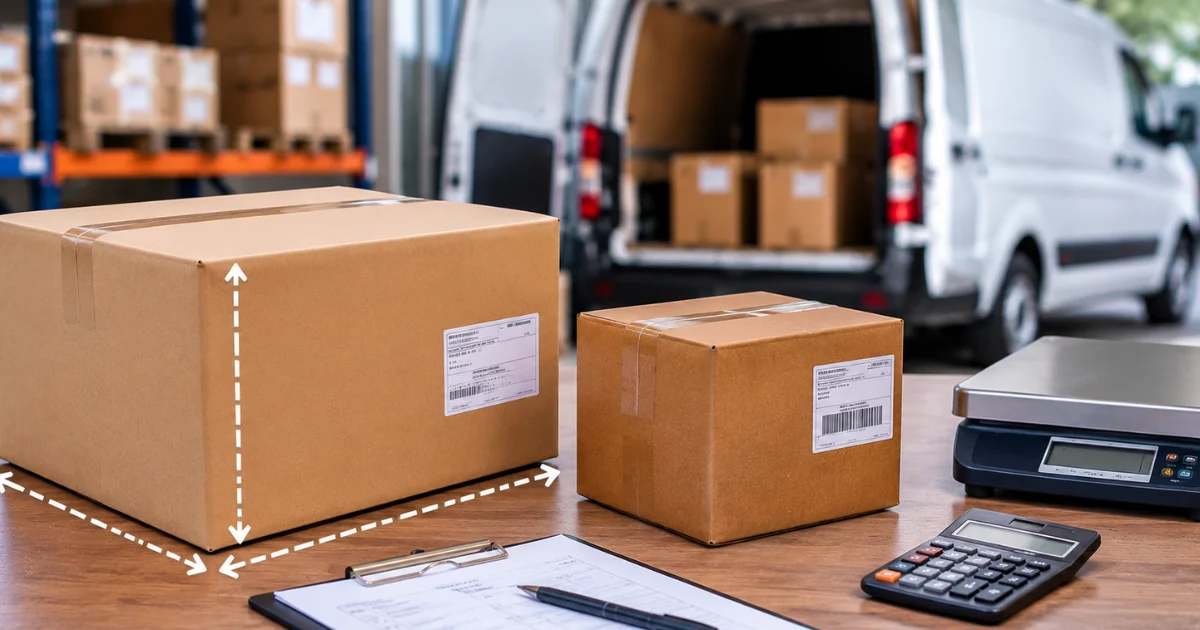
You can calculate volumetric weight by multiplying the parcel’s length, width and height, then dividing the result by the courier’s volumetric divisor.
The general formula is:
Volumetric weight (kg) = Length × Width × Height (cm) ÷ Volumetric divisor
The divisor converts the parcel’s dimensions into a weight equivalent. It varies between courier companies and transport services, so always check the relevant provider’s pricing rules before calculating a quotation.
Example: Calculating the Volumetric Weight of a Parcel
Suppose you need to send a parcel with these dimensions:
- Length: 60cm
- Width: 40cm
- Height: 30cm
- Actual weight: 8kg
First, calculate the parcel’s volume:
60 × 40 × 30 = 72,000 cubic centimetres.
For illustration, assume the courier uses a divisor of 5,000:
72,000 ÷ 5,000 = 14.4kg volumetric weight.
The comparison is therefore:
- Actual weight: 8kg.
- Volumetric weight: 14.4kg.
- Chargeable weight: 14.4kg, if the service uses the higher figure.
This example demonstrates how a relatively light parcel can have a higher chargeable weight because of its dimensions. The divisor of 5,000 is illustrative, not a universal courier standard.
What Volumetric Divisor Do Couriers Use?
There is no universal volumetric divisor across the courier industry. Different companies may apply different divisors depending on whether they provide domestic parcel delivery, international shipping, air freight or road transport.
For example, a courier may use a divisor of 5,000, while another service may use 4,000 or a different figure. These values are examples of possible calculation methods, not a statement of any particular provider’s current tariff.
Before calculating the chargeable weight, check:
- Whether the courier uses centimetres or metres.
- Which volumetric divisor applies to your chosen service.
- Whether the calculation uses the parcel’s external dimensions.
- Whether the courier rounds the result up to a whole kilogram or another weight increment.
- Whether additional size or handling restrictions apply.
If you are comparing quotations, make sure you use the same dimensions and understand the calculation method behind each price. Otherwise, two quotations may appear different simply because the providers use different pricing rules.
Why Does Volumetric Weight Affect Courier Charges?
Delivery vehicles have limited space and weight capacity. A courier cannot fill a van or truck with large, lightweight parcels as efficiently as it can with compact consignments.
Volumetric weight helps transport companies account for the space used by each shipment, particularly when carrying a mixture of heavy and lightweight goods.
It can affect delivery charges in several ways.
1. Large Parcels Can Cost More to Deliver
A large parcel may occupy substantial space even when its contents are relatively light. The volumetric calculation accounts for this difference when determining the chargeable weight.
2. Packaging Can Increase the Chargeable Weight
Oversized boxes, excessive protective material and unnecessary empty space can increase the external dimensions of a shipment.
For example, a product that fits into a 40cm × 30cm × 20cm box may have a higher volumetric weight if it is packed into a 60cm × 40cm × 30cm box.
3. International and Air Freight Services Often Consider Dimensions
Air freight capacity is particularly sensitive to the amount of space a shipment occupies. Dimensional weight calculations help carriers allocate that capacity and price shipments accordingly.
However, domestic road courier services may use different charging methods. Some may consider vehicle space, load dimensions, delivery distance, vehicle type or dedicated transport requirements rather than applying a standard parcel divisor.
4. The Chargeable Weight May Be Higher Than the Actual Weight
If the volumetric weight exceeds the physical weight, the courier may charge according to the volumetric figure. If the actual weight is higher, the physical weight may determine the charge instead.
Always check the terms of the selected service.
How Can You Reduce Volumetric Weight?

You cannot always reduce the dimensions of a product, particularly when transporting furniture, equipment or fragile goods. However, you can avoid unnecessary packaging space and improve how efficiently your shipment is prepared.
Consider these practical steps:
- Choose appropriately sized packaging: Use a box that fits the product while leaving enough room for suitable protective material.
- Avoid unnecessary empty space: Excessive gaps can increase the external dimensions without improving protection.
- Measure the finished parcel: Measure the outside of the fully packed box rather than relying on the product’s dimensions.
- Use suitable packaging materials: Select protective materials that secure the contents without adding unnecessary bulk.
- Compare packaging options: Where suitable, consider alternative box shapes or packaging methods that protect the goods while using less space.
- Check the courier’s restrictions: Some services have maximum dimensions, weight limits and additional handling charges.
Do not compromise the protection of fragile or valuable goods simply to reduce the parcel size. Proper packaging should remain the priority.
What Happens When a Shipment Is Too Large for Standard Courier Delivery?
Not every consignment is suitable for a standard parcel courier. Large, bulky or heavy items may require a dedicated vehicle or a different transport arrangement.
For example, a business sending several pallets of stock may need a Luton van, 7.5-tonne truck or larger vehicle rather than a standard parcel service. In these situations, transport requirements may depend on the total load, pallet dimensions, weight, collection and delivery access, and whether the vehicle needs loading equipment.
This is an important distinction: volumetric weight is particularly relevant to parcel and air freight pricing, but it is not necessarily the pricing method used for every road transport or heavy haulage booking.
For larger consignments, it is usually more useful to provide the transport company with the actual weight, dimensions, number of pallets, collection address and delivery address so it can assess the appropriate vehicle and service.
How Does SirdarJi Couriers Help with Different Delivery Requirements?
SirdarJi Couriers provides UK courier and transport services for businesses and individuals sending consignments of different sizes and weights.
For standard parcels, the dimensions and physical weight can help establish the appropriate delivery arrangement. For larger or heavier consignments, the team can assess the load and identify a suitable vehicle from its fleet.
Available vehicle options include:
- Small vans: Suitable for smaller consignments and compact deliveries.
- Sprinter vans: Offer additional load space for larger courier consignments.
- Luton vans: Useful for bulky goods and certain pallet deliveries, with tail-lift availability.
- 7.5-tonne trucks: Suitable for larger commercial loads.
- 18-tonne and 26-tonne trucks: Provide additional capacity for substantial pallet and freight movements.
- 44-tonne articulated vehicles: Used for larger-scale transport requirements where the load and access conditions are suitable.
SirdarJi also offers same-day, next-day and dedicated transport options across the UK. The right service depends on the shipment’s dimensions, weight, urgency and delivery requirements.
If you need to arrange a delivery, provide the parcel or load dimensions alongside its actual weight. This helps the team understand the shipment and assess the most suitable transport option.
Frequently Asked Questions
Is volumetric weight the same as dimensional weight?
Yes. Volumetric weight and dimensional weight generally describe the same concept. Both estimate the weight equivalent of the space a parcel occupies. The terminology can vary between courier companies and transport providers.
Is volumetric weight always higher than actual weight?
No. It depends on the parcel’s dimensions and physical weight. A compact, heavy parcel may have a higher actual weight, while a large, lightweight parcel may have a higher volumetric weight.
Do all courier companies use the same volumetric weight formula?
No. Although the basic calculation uses length, width and height, the divisor, rounding rules and chargeable-weight policies can differ between providers and services.
Should I measure the parcel before or after packaging?
Measure the parcel after packaging. Couriers generally need the external dimensions of the finished shipment, including the packaging and any protruding parts.
Does volumetric weight apply to pallet deliveries?
Some freight and pallet services use volume, dimensions or space-based calculations when assessing transport requirements. However, they may use different pricing methods from standard parcel couriers. Always check the transport provider’s rules.
How can I find out the chargeable weight of my parcel?
Measure the parcel’s external length, width and height, calculate its volumetric weight using the courier’s stated divisor, and compare the result with the actual weight. Follow the provider’s rounding and pricing rules to establish the chargeable weight.
Can I reduce courier charges by using smaller packaging?
Potentially, yes. If smaller packaging reduces the parcel’s external dimensions, it may lower its volumetric weight. However, packaging must still protect the contents and meet the courier’s requirements.
Final Words
Volumetric weight explains why courier charges are not always based on the physical weight of a parcel. Its dimensions can be just as important, particularly when transporting large, lightweight goods.
By measuring parcels accurately, choosing appropriate packaging and checking the courier’s volumetric divisor, you can estimate chargeable weight more reliably and avoid unexpected pricing differences.
For larger consignments, pallets or heavy goods, consider the overall transport requirements rather than relying on parcel volumetric weight alone. Providing accurate dimensions, weight and delivery details will help a courier recommend an appropriate service.